Reusable presentation system / v1
Source.
Solve. Outcome.
One visual grammar for the scan, its evidence, and the work made from it. The data changes. The reading order does not.
01 / Foundation
The site is quiet.
The reconstruction does the talking.
Keep the approved technical rendering. Use regular-weight typography, neutral surfaces and consistent spatial cues. Do not replace measured or solved structures with illustrative ones.
Interface / green
Navigation, selected controls and small active labels. Green is not a substitute for a scientific scalar legend.
Cameras / cyan
Saved centers, frustums and ordered connectors. The selected camera is brighter and heavier; position stays unchanged.
Relationships / amber
Selected correspondences or rays. Always distinguish saved feature links from computed ray–surface intersections.
Surface / restrained
Preserve source appearance where available. Neutral, tan or magenta display materials must be labeled as visualization, not natural color.
Motion / direction
A direction arrow need not encode speed. A speed color scale is allowed only when its underlying rate has been calculated and identified.
Context / gray
Background points, inactive cameras, metadata and uncertainty. Hierarchy comes from contrast, not from extra visual effects.
02 / The component
Same controls.
Different spatial questions.
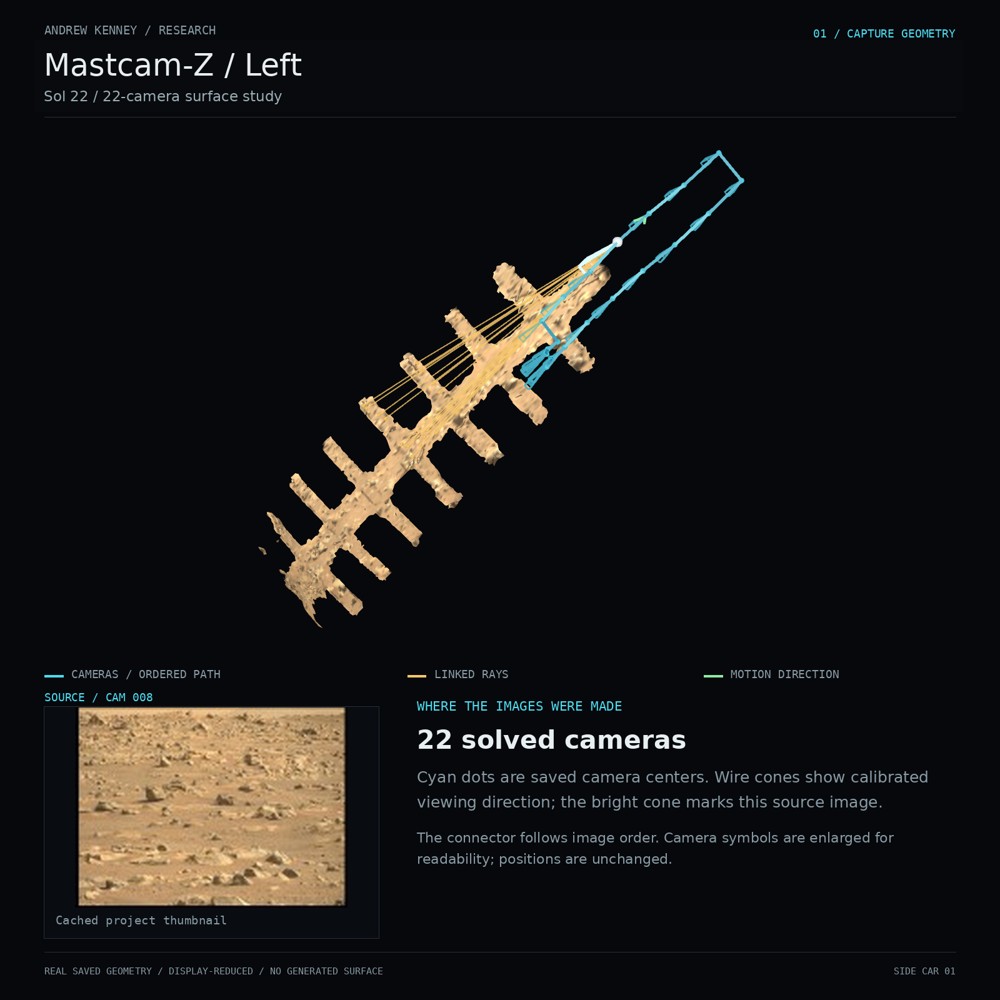
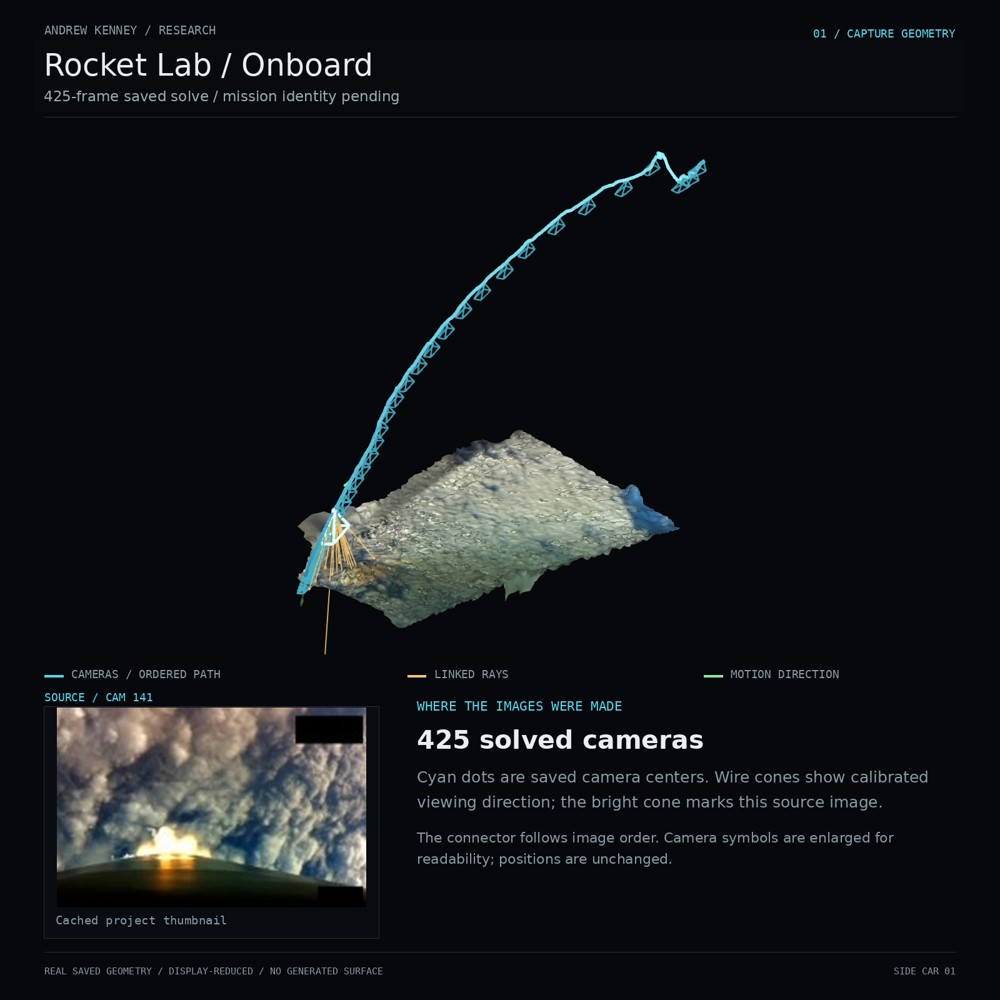
- Frame
- 1:1 for the main media and explainers. Fit the entire relevant scene; do not crop cameras away to fill the square.
- Source panel
- Approximately one-third of the canvas width. Actual source pixels; label cached thumbnails, video derivatives and processed images.
- Geometry
- Keep cameras, matches and surfaces in the same coordinate frame. Only a shared rigid transform and uniform display scale may be applied.
- Symbols
- Marker size and frustum depth are display conventions. Enlarge them for legibility without changing the underlying centers or orientations.
- Density
- Sample points or camera symbols for clarity when needed; keep exact counts in the record. Never silently present a sampled view as complete.
- Motion
- The overview orbit explains spatial relationships. Source playback explains acquisition order. Neither is mission-time playback unless explicitly mapped.
- Captions
- Mission / object → instrument / method → specific capture → source. Working folder names remain in provenance, not necessarily in public headlines.
03 / Case-study anatomy
Connect process to the result.
Source
What was photographed, by whom, with which camera or instrument. Show an actual input.
Solve
Reveal viewpoints, matches and recovered geometry. State what failed or remains incomplete.
Outcome
Show the mesh, film, image or physical result. Keep the exact connection to the scan documented.
Evidence
A secondary layer holds IDs, source references, processing, scale, timing and omissions.
A trophy, a body, a room and a landscape do not need the same camera move. They need the same clear relationship between input, reconstruction and authored output.
This version is implemented and checked with six space studies. The template supports non-space scans, but a second object/interior dataset has not been imported or claimed as tested.
Open the reusable template ↗04 / Data contract
One record per scan.
No ambiguous pairings.
{
  "id": "perseverance-mastcamz-sol22-left",
  "title": "Perseverance / Mastcam-Z left",
  "capture": {"type": "mission-imagery", "instrument": "Mastcam-Z left", "sol": 22},
  "source": {"owner": "NASA / JPL-Caltech / ASU / MSSS", "status": "filename-verified"},
  "solve": {"chunk": 0, "component": 0, "camera_count": 22},
  "display": {"aspect_ratio": "1:1", "geometry_policy": "preserve-relative-positions"},
  "measurement": {"kind": "pointing-rate", "unit": "deg/s", "physical_scale": null},
  "outcome": {"kind": "camera-space-film", "pairing_status": "same-saved-solve"}
}05 / Acceptance checks
What must stay true.
- Every visible source image maps to an actual source file or a documented preview of it.
- The selected camera, source preview and reconstruction belong to the same solve/component.
- Missing data stays missing; no generated terrain, infill, trajectory or source photo is substituted.
- Field names and timing come from the correct mission schema, not from a different rover’s naming convention.
- Unknown scale, timing, flight identity and output pairing remain explicitly unknown.
- Videos and stills are readable at site size; source attribution and keyboard/mobile access remain available.